Multi-Fruit Sorting
Object- and destination-specific subtask instructions in familiar layouts.









† Co-corresponding authors
Can changing only the language instruction redirect a vision-language-action (VLA) policy’s end effectors, or does the visually driven motion prior dominate? We present AMC (Atomic Motion Coordinate), a geometry-grounded coordinate for steerable and force-responsive manipulation. Each arm owns thirteen translation, rotation, and hold atoms grounded through text and forward kinematics with vision withheld. Under full observation, the resulting coordinate is injected into every action-expert block through a cross-attention residual. Contact history modulates the same coordinate through a bounded spherical residual, recomputed from a fixed nominal latent to regenerate only the unexecuted horizon suffix.
Across 7,520 matched offline interventions per policy, AMC achieves 92.5%/83.1% opposite-atom separation for single/dual interventions, compared with 39.1%/24.0% for LA4VLA-style. Across 50 real-robot trials per reported method–task pair, AMC improves out-of-distribution fruit progress over fine-tuned π0.5 from 60.5% to 87.8%. Adding force adaptation improves Plug/Vase progress over force-free AMC from 59.0%/71.6% to 78.5%/75.2%.
Same images and robot state; only the language instruction changes.
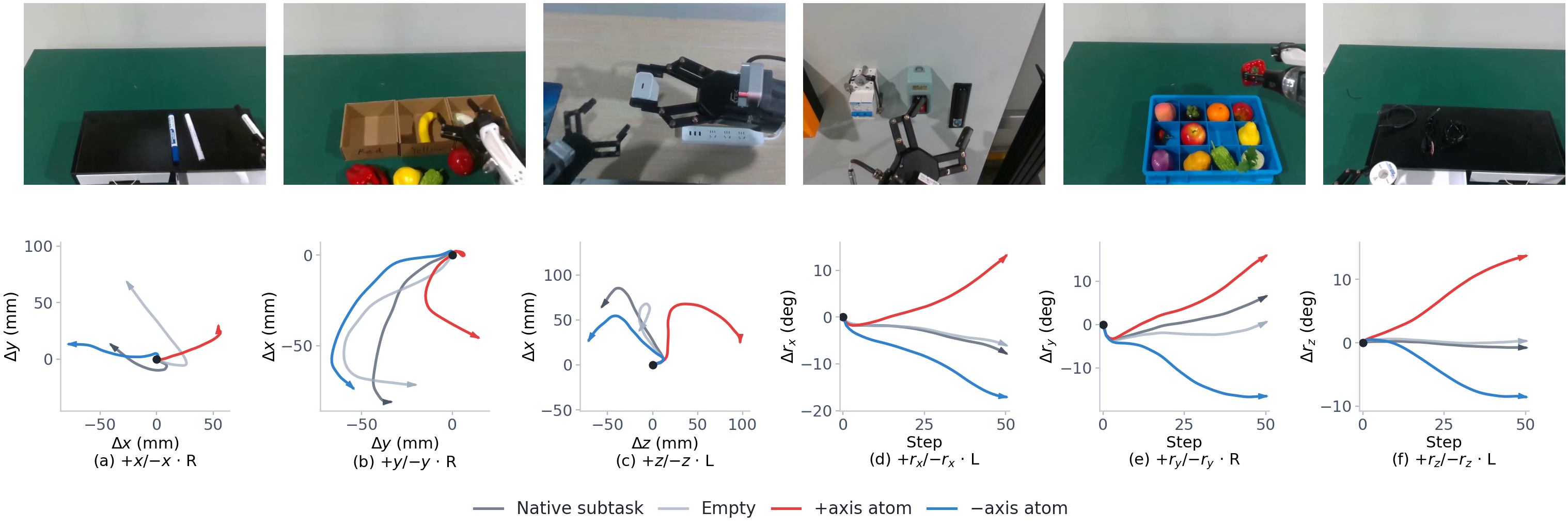
Offline FK evaluation on 7,520 matched interventions per policy. Single requests one signed direction; Dual requires two compatible directions on one arm. Pair separation measures whether opposite prompts are correctly ordered.
| Method | Single pair separation | Dual pair separation |
|---|---|---|
| Fine-tuned π0.5 | 18.1 | 8.1 |
| LA4VLA-style | 39.1 | 24.0 |
| RSS | 60.7 | 22.5 |
| AMC | 92.5 | 83.1 |
Paper steering evaluation, using the non-spherical AMC 50K checkpoint. The real-robot videos below test object- and destination-specific task instructions.
Updated comparison clips use consistent model labels and trial-end status overlays; footage is shown at 5× speed. Watch the full four-task comparison.
Object- and destination-specific subtask instructions in familiar layouts.
Subtask steering with unseen fruit and target-box placements.
Opening, reorientation, alignment and contact-rich insertion.
Coordinated stabilization, rotation and sustained wiping contact.
Mean normalized task progress (%) over 50 trials per reported method–task pair.
| Method | Fruit | OOD Fruit | Plug | Vase |
|---|---|---|---|---|
| Fine-tuned π0.5 | 82.7 | 60.5 | 55.0 | 65.2 |
| RSS | 54.5 | 39.1 | — | — |
| LA4VLA-style | 60.7 | 40.4 | — | — |
| ForceVLA | — | — | 30.0 | 40.4 |
| AMC | 88.9 | 87.8 | 59.0 | 71.6 |
| AMC + Force | — | — | 78.5 | 75.2 |
Mean normalized progress over 50 trials per reported method–task pair. “—” denotes an untested pair.